Sunday, 29 July 2018

Corpse Bride (Tim Burton, 2005)

Introduction
This journal's focus will be mainly discussing on German Expressionism. It is a filmic style that emerged in Germany from year 1919 to year 1926. The advent of this filmic style was influenced by the Expressionist movement in modern art of early 1900s. Expressionism was not limited to painting only, but was manifest in literature, theatre and architecture. Besides, there are several themes included in German Expressionism such as revolt, self-analysis, sexual savagery and madness as well as primitive.

Theory Discussion
According to Zilvertong (2014), Corpse Bride consists of many elements that are used by German Expressionism, as the features included distorted perspective, disturbed relationship and angles, use of strong contrast and shadows (para.1). Not only that, according to Film Theory (2014), the dominant characteristics of expressionism include the use of heavy atmosphere, the evoke of mystery and hallucination, as well as the set of camera in unexpected angles which gives different perception (para.5). Follow by, some of the scenes in Corpse Bride will be mentioned to further explain these traits.

Synopsis
Victor Van Dort and Victoria Everglot were betrothed because the Everglots needed money and the Van Dorts wanted to gain social status (XxCherrySodaxX. n.d.). Though it was the first meeting, they fall for each another. After Victor bungled the wedding rehearsal, he went practising his vows in the forest. Victor put his ring on a branch-like finger, which then awoken Emily - the corpse bride. Emily claimed Victor to be his groom and brought him to the land of the dead. As the Everglots could not wait for Victor's return, they decided to marry Victoria off to Lord Barkis. Victor, feeling betrayed, planned to end his life and marry Emily. As Emily realized she was denying Victoria's chance at happiness, she let go of Victor and transformed into swarm of butterflies under the moonlight (Wikipedia, n.d. para.6).

Analysis

There are two themes from German Expressionism which could be found in Corpse Bride (2005) - revolt and self-analysis. For the first theme - revolt, it could be seen from the scene where Victoria escaped from her room by the window after she was locked in the room by her parents. As Victoria told her parents that Victor was forcibly wed to a corpse bride, they thought that she had lost her mind and planned to marry her off to Lord Barkis. Though her rebellious action was at last of no use, but it proved that Victoria had tried to oppose her parents by seeking help from the pastor.

The next theme in the movie is self-analysis. This theme was shown vividly in Emily - the corpse bride. She was very stubborn in having Victor as his groom initially. When she discovered the real reason of Victor's request for returning to the land of the living, which is to meet with Victoria, she was very angry and chanted "Hopscotch" to bring both of them back to the afterlife. Her self-analysis occurred when she saw Victoria hiding behind the pillar as Victor was about to consume the poisonous drink. "You kept your promise. You set me free. Now I can do the same for you." was the last sentence she said when she realized her selfish doing was wrong.

The following analysis will be on the traits of German Expressionism. The first trait will be distorted bodies. For example, Victor, the shy and clumsy protagonist, has strange physique, which include extraordinary big eyes, big head, stick-like body and hunched back. This character provides a sense of similarity with the protagonist from the movie - The Cabinet of Dr Caligari (1920). Both of the protagonist also walked in a strange way. To be exact, most of the living characters in this movie had strange bodies. Victor's mother bloated in a strange way whereas Victor's father looked exactly like him.

In addition, distorted perspective could also be found in the movie. For example, the land of the living is darker meanwhile the land of the dead is more colorful. This tends to oppose the common sense the audience possesses in mind - the living should be happier and the afterlife ought to be scarier. In Corpse Bride, the land of the living reflected the bureaucratic side of life and the land of the dead is more joyous and musical (The Guardian, 2005, para.4).

The use of strong contrast and shadow was also applied in this movie. When Victor's vows awoken Emily from death, the low-key lighting created a dramatic shadows. This scene evoked a strong sense of fear in the audience. Apart from that, the other scene with high contrast was the scene when Victor finally found the ring he accidentally fall onto the ground. This scene heightened up the audience's expectations of how Victor was about to be condemned by his reckless behaviour.

Moreover, the content in the movie was surreal and gothic. The unnatural realities could be observed in the land of the dead such as singing skeleton, moving head and skeleton pet dog. Besides, according to What is Goth (n.d.), gothic could be defined as things that someone find it beautiful whereas the others find it to be dark (para.1). Emily could be the best example of element "gothic" found in the movie. Her appearance was frightening yet alluring at the same time.

Conclusion
Corpse Bride (2005) is a movie which consists of elements which vary from what we could perceive from ordinary film. It metaphors how cruel the real life looks like and changes how the audience could perceive the afterlife. This movie enables audience to view things differently by distorting things visually and cognitively. The value that can be learnt from this movie is to let go of thing that does not belong to oneself.

Reference
1. Film Theory (n.d.). German Expressionism. Retrieved from
http://filmtheory.org/german-expressionism/

2. The Guardian (n.d.). 'Corpse Bride? It's just a love story with skeletons'. Retrieved from
https://www.theguardian.com/film/2005/oct/14/2

3. What is Goth (n.d.). What is Goth. Retrieved from
http://www.whatisgoth.com/

4. Wikipedia (n.d.). Corpse Bride. Retrieved from
https://en.wikipedia.org/wiki/Corpse_Bride

5. XxCherrySodaxX. (n.d.). Corpse Bride (2005) :Plot. Retrieved from
https://www.imdb.com/title/tt0121164/plotsummary#synopsis

6. Zilvertong. (2014). The Influence of German Expressionism in Corpse Bride. Retrieved from
http://zilvertong.tumblr.com/post/105864280329/the-influence-of-german-expressionism-in-corpse

Sunday, 22 July 2018

Bicycle Thieves (Vittorio De Sica, 1948)

Introduction
This journal will be mainly focusing on Italian Neorealism. This theory was founded by Cesare Zavattini in 1942, which suggested a new style of Italian Cinema that abolishes planned plots. This new form uses real people and locations so that direct contact is established with contemporary social reality, which was the life after Italy had surrendered to Germany during World War 2. To be more accurate, contemporary social reality unconditionally emphasizes on the ordinariness of daily lives.

Theory Discussion
Italian Neorealism was known as a cinema filled with poverty and pessimism. However, its decline began in the fifties as the nations were changing for the better and it was not economically profitable in Italy. The movie that will be discussed soon, Bicycle Thieves (1948), can be classified as Italian Neorealism due to fulfillment of the following traits : possesses melodramatic aspects, references to contemporary national experiences, used mixture of professional actors and non-actors, and mostly shot on-location, in the ruins of the post-war era.

Synopsis
Ricci Antonio, an unemployed man in the depressed post-World War 2 economy in Italy, was offered a job to hang up posters - for which he needed a bicycle (IMDb, n.d.). As his job required a bike, his wife then sold six of their bed sheets to redeem their bike at the pawn shop. On Ricci's first day of working, his bicycle was stolen as he was hanging up posters. Ricci, with his son's companion, had tried several attempts to trace back the bike by reporting to the police, seeking help from his friend Baiocco, approaching the old man who conversed with the thief. Despite located the thief, Ricci's accusation was of no use as he had no proof. He himself at last became a bicycle thief due to his keenness to retain his job. Unfortunately, he was caught by a group of man, right in front of his son.

Analysis

Bicycle Thieves (1948) had few scenes which consisted melodramatic aspects. According to Filmsite (n.d.), melodrama films are characterized by plot to appeal to the heightened emotions of the audience. The word "melodrama" consists of drama and melos-music, which means "play with music" (para.1). For example, Ricci frowned and looked around hopelessly as he failed to chase after the thief who stole his bike. This scene was accompanied with melancholy music to better enhance his state of mind - which is puzzled and depressed.
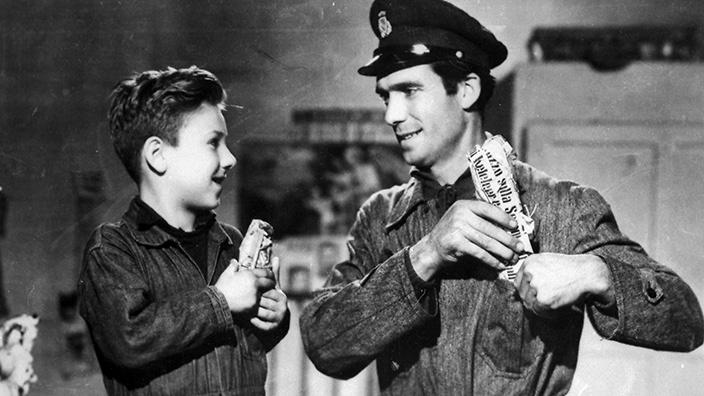
Besides, the other scene which possessed melodramatic aspect is when Bruno realized his father was cycling a stolen bike. This particular scene was very dramatic as Bruno facial expression showed how confused he was when he saw men were chasing after his father. His mixed feelings were accompanied by tense music as the group of men almost caught his father.

The second aspect of Italian Neorealism which was shown in the movie is references to contemporary national experience. According to History (n.d.), Gen. Dwight Eisenhower publicly announced the surrender of Italy to the allies (para.1). As the movie was filmed in year 1948 which was post-WWII, unemployment rate was high and citizens were eager to be hired. In order to complement the contemporary, the movie showed a large crowd of men gathering in front of an employment office in Valmelaina. This is why Ricci was delight yet upset at the same time when he got a job in the lackluster Italian economy (GradeSaver, n.d., para.1). Furthermore, the post-war contemporary was shown in the scene where many citizens lined up to pawn their belongings. People who used to live in comfort had no choice but to pawn things such as linen, binoculars and etc.

The used mixture of professional and non-professional actor was applied in this movie as well. According to Snider (2015), most of the casts were non-professional actors. The aesthetic of Italian Neorealism was to use non-actors or at least actors who are good in being natural. Director Vittorio De Sica had mentioned that it is difficult for a fully trained actor to forget his profession (para.3). Therefore, the only professional actor in the movie was the officer who announced employed workers in front of the employment office.


Furthermore, mostly of the scenes in Italian Neorealism were shot on-location, which were in the ruins of the post-war era. This aspect can relate the audience to the scenario of lives after war. In the movie, there are few scenes which can reflect this aspect. For example, there were many newly built apartments in the movie. When Ricci was offered a job, he went back to find his wife who was busy with her chores. The buildings were neat and clean, which reflects citizens who were rebuilding their nation after WWII. In addition, there was one scene where the old guy tried to run away from Ricci and Bruno on the bridge at the town. This scene showed the tranquility of Italy after they had surrendered to their allies in WWII. Citizens were able to mobile in town areas without restrictions and curfews as the nation was freed from war. Moreover, the other on-location shot is the cheers for "Forza Modena" team in the stadium. When Ricci was having his dilemma of whether to steal the bicycle or not, there were cheers from the stadium. It was not a planned event; instead, it was a real footage on the day of filming at the location. Citizens can enjoy watching matches in stadium which also proved peaceful lives after war.

Conclusion
Bicycle Thieves (1948) is a black and white film that showed the unfortunate life of an unemployed man. His persistence in searching for his stolen bike was a futile as no one believed in his accusation. This sorrowful film had a tragic ending where Ricci Antonio unable to get back his bike as well as showed Bruno his vulnerable side. The moral value behind Bicycle Thieves is that one can lose everything in his or her life except self-esteem.

Reference
1. Filmsite (n.d.). Melodrama films. Retrieved from
http://www.filmsite.org/melodramafilms.html

2. GradeSaver (n.d.). Bicycle Thieves Summary. Retrieved from
https://www.gradesaver.com/bicycle-thieves/study-guide/summary

3. History (n.d.). Italian surrender is announced. Retrieved from
https://www.history.com/this-day-in-history/italian-surrender-is-announced

4. IMDb (n.d.). Bicycle Thieves (1948): Plot. Retrieved from
https://www.imdb.com/title/tt0040522/plotsummary

5. Snider, E. D. (2015). 11 Heart-Stealing Facts About Bicycle Thieves. Retrieved from
http://mentalfloss.com/article/70637/11-heart-stealing-facts-about-bicycle-thieves

Monday, 9 July 2018

In The Mood For Love (Wong Kar-Wai, 2000)

Introduction
This journal will be mainly discussing about French Impressionist Cinema. It was popular from year 1919 to year 1928. The films produced usually exposed audience with in-depth psychological cognitive activities, which is very much different from 21st century's films. Majority of the modern films consist of hard-core action or hilarious elements which satisfied with vast audience's taste whereas French Impressionism was a generation where films explore the psychological causes of the narration. Therefore, its generation faded as it failed to retain the audience and the production costs rose.

Theory Discussion
French Impressionist Cinema concerns on mental states of the actors. It also visually depicts mental states through cinematography and editing, which is very much fitted in the film "In The Mood for Love" by Wong Kar-Wai. For example, the the rhythmic editing and POV editing are used to display characters' experience in particular situation. Cam movements is usually smooth, without steamy scenes that will create excitement. Visuals are usually filtered or vertiginous to show the dizziness or the emotions of the casts.

Synopsis
In The Mood For Love (2000) is a film which tells about two unfortunate individuals which are betrayed by their own spouses. Mrs Chan, who works as an executive assistant, and Mr Chow, who works as a newspaper reporter, are tenants who coincidentally rented rooms in apartments next to each other in the crowded Hong Kong of 1962 (Ebert, 2001, para.3). Since both the protagonists are always working til late night, their spouses seize the opportunity to have adultery affair behind them. After they had discovered such incident, they meet to practice and imagine how did their other half cheat on them. From the shared agony of adultery, Mrs Chan and Mr Chow have slowly developed a unique bond between themselves (Saleh, 2011, para.2). The film showed the dilemma of upholding their moral values and falling in love with each another.

Analysis
As mentioned earlier, this film is more focusing on the emotional and mental state of the casts, instead of showing them out directly. Follow by, there are some scenes which I personally find it interesting to analyze based on the theory of "French Impressionist Cinema".

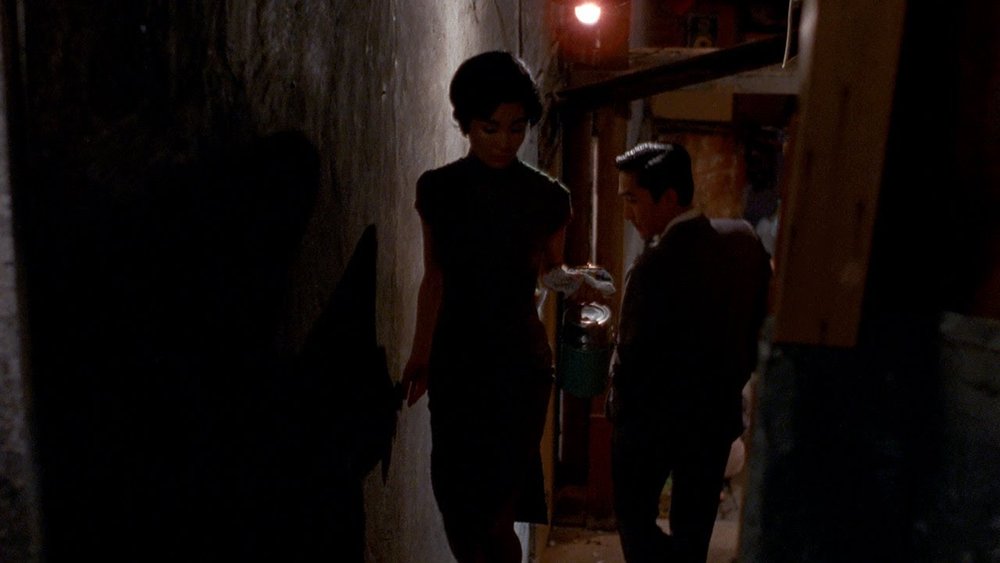
First of all, throughout the film, audience could barely see the faces of the protagonists' spouses. It is either their backside or their shadows. This filming technique of Wong Kar-Wai's is a fantastic way in displaying the absence of the spouses in their lives. It is always bidding farewell and feeling lonely. For example, there was one scene when Mrs Chan was chit-chatting with Mr Chow's wife at the doorstep of her staying. Throughout the conversation, there was only Mrs Chan's face shown in the scene. Though Mrs Chan pretended to have no ideas about the adultery affair in front of Mr Chow's wife, but it is clear that her eyesight had overwhelmed with despair and grief.

Besides filming technique, the cam movement in the entire film is slow. Slow movement can best depict the emotional perspective of the characters. This is best shown when Mrs Chan was helping Mr Chow in his martial arts writing at his room. The cam movement is very slow and shows the inner feeling of both the protagonists. When Mr Chow is focusing on this pieces, Mrs Chan stared at him with a sweet smile on her cheek. This also shows that both the protagonists wish to freeze the time and remain at this very moment of happiness.

Mentioning about emotional aspect, rhythmic editing also plays an important role in this film. It is shown in multiple shots when Mrs Chan going up and down the stairs, back and forth the corridor. These scenes reflect the frantic thoughts of her inner struggles on whether she should or should not meet Mr Chow at his hostel room (Thinkinghut, 2016, para.12). Audience are brought into her state of mind whether she should be firm of her moral principle or summon her courage to meet her "Mr.Right". Rhythmic editing therefore indirectly triggered the audience's expectation.

Rhythmic editing appears not only for visual but also soundtracks. Yumeiji's Theme appeared eight times throughout the film, mostly accompanied with scenes which showed Mrs Chan's and Mr Chow's daily routine. Strolling down the street, walking down the stairs, having noodles at the stall and passing by each another are the things that happen over and over again. Both of them are looking fine on the outside but are swallowed by solitude day by day. This song contains sense of melancholy which shows the sorrow of the protagonists covertly.

Not only that, the costumes and the setting of the film disclose the psychological aspect of the characters too. Since the stereotypes and gossips are overwhelming around the neighborhoods, the characters choose to keep everything to themselves. For example, the clothing the protagonists wear are always tightening and suffocating, the hallway of the apartment is very narrow, and the facial expression of the protagonists are always moody. These elements metaphors the generation where people are narrow-minded, privacy are hard to be kept and gossips are here, there and everywhere. Therefore, when the landlady advised Mrs Chan not to go out too often and ought to retain her husband, she decided not to have frequent contact with Mr Chow to avoid from gossips.

Conclusion
In The Mood For Love is by far the most artistic romance film I had ever watched. It is very much different from modern film as you have to think and decode the meaning behind every scene. The path they chose are definitely not a perfect but a beautiful ending. The film very much reflects the reality where you have to sacrifice something, or even someone you love. It gets better every time you watch it!

Reference
1. Ebert, R. (2001). In The Mood For Love. Retrieved from:
https://www.rogerebert.com/reviews/in-the-mood-for-love-2001

2. Saleb, R. (2011). DFI Film Review. In The Mood For Love (2000). Retrieved from:
http://www.dohafilminstitute.com/blog/dfi-film-review-in-the-mood-for-love-2000

3. Thinkinghut (2016). In The Mood For Love: French Impressionism and Plot Analysis. Retrieved from:
https://thinkinghut.wordpress.com/2016/08/06/in-the-mood-for-love-french-expressionism-and-plot-analysis/

Monday, 2 July 2018

Paranorman (Sam Fell & Chris Butler, 2012)


Introduction
The main focus for this journal will be discussing about postmodernism. It promotes reflective stands on social, political and cultural agendas and resonances. Daniel Palmer (2014) once asked his students what postmodernism actually meant, and one of his students replied that "It is when you put everything in question mark"(para.1). In other words, postmodernism is about questioning the existing knowledge. People are often skeptical about the criteria we set for a particular structure and will somehow revise them. Therefore, in a postmodernist's viewpoint, there are no universal truths.

Theory Discussion
Postmodernism can be fall under two categories which are simulation and prefabrication. Simulation includes parody and pastiche whereas prefabrication includes intertextuality and bricolage. As mentioned earlier, postmodernism tends to blur the strict boundaries for structures; hence, the postmodernist component found in the film Paranorman is hybrid genre. According to Oxford Reference (n.d.), hybrid genre can be defined as the combination of two or more genres (para.1). For the film Paranorman, the genres that could be determined are horror and comedy. Therefore, Semantic/Syntactic Approach that is proposed by Rick Altman could no longer work in hybrid genre.

Synopsis
Paranorman is a stop-motion animated film which is directed by Sam Fell and Chris Butler. The story tells about a boy, Norman Babcock, who has the ability to visualize and communicate with the ceased souls. He was bullied due to his extraordinary ability by his peers. But somehow, there was a boy named Neil Downe who believed all Norman's doings. Norman was then forced by his uncle to inherit the obligation of protecting the town, by reading story to the witch every year. Norman eventually failed the task, enabling the awaken of the witch and the cursed dead. After understanding the witch's past, Norman insisted to persuade and rescue the witch. At last, the curse was broken and the witch as well as the cursed dead could finally rest in peace.

Analysis
As mentioned earlier, Paranorman can be classified as a horror-comedy genre hybrid film. Follow by, there are certain scenes' mise-en-scene and syntax which can prove so.

Norman's failure in reading the story at the exact location induced the arisen of the witch, Aggie, and the zombies. Based on this particular scene, this film can be classified as having horror element due to the appearance of the unnatural, which are the witch and the zombies. The syntax of horror could exactly be found when the zombies entered the town. The normalcy of town was disrupted by the advent of the cursed dead. There was an uproar in the town where the civilians attacked the zombies in order to protect themselves. In fact, the real threat was Aggie, the witch who wanted to avenge for herself. The dark clouds with demonic laughing faces could perfectly portray the visual perspective of a horror film.

Except for being an horror film, there are some laughable characters which can prove Paranorman as a comedy film. The best one would be the bully, Alvin. He was a good-for-nothing guy who did mischievous acts such as trying to impress a couple of girls, bullying Norman who always had conversation with the thin air, mocking Neil's appearance despite he himself being far from a beacon of physical health himself and etc. At first, he seemed to be a tough guy, but he turned to be a coward when facing with the apocalypse of the cursed dead. His dramatic personality had clearly displayed the visual perspective of comedy.

Besides, Courtney Babcock who treated her younger brother, Norman Babcock, poorly turned to be feminine and kind when confronting with Mitch Downe. Courtney was attracted by Mitch's physique when he appeared to be topless in front of the door. She acted to be weak and needy in front of  Mitch so that he could give her some affection. The contrast of Courtney treating Norman and Mitch had reflected the theme of exaggerated situation of comedy.

Paranorman could be considered as a postmodernist film due to some of its elements. The first element would be breaking the mindset towards the villains. The cursed dead were expected to be brain-eating and threatening zombies. In fact, they were afraid of the civilians and was longing for Norman's help to set them free. They were cursed by Aggie and could not proceed to the afterlife. Other than that, Mitch Downe's confession of his sexual orientation was the second element which represented postmodernism. As he was seemed to manly and muscular from beginning to end, it was a big plot twist for the audience when he mentioned "my boyfriend". This particular scene broke the traditional labeling of the connection between masculinity and heterosexuality.

Therefore, Semantic/Syntactic Approach could not work under postmodernist film. Under this approach, each genre has a set of distinctive criteria. Hybrid genre, which is one type of postmodernism, broke the structure of the respective genre and mixed them around to produce a new film. Hence, the genre's criteria were altered and opposed the Semantic/Syntactic Approach's manner of categorizing film. Film with mixing genres could no longer be classified with this method.

Conclusion
Paranorman is a film which consists of more than one genre. The characters have inimitable personality which made Paranorman a good film to be enjoyed. Postmodernist elements could be found throughout the film and most importantly, audience are taught not to judge a book by its cover. Man, woman and child ought to leave aside of their biases, step out of their comfort zone and expose themselves to new strange things.

Reference
1. Oxford Reference (n.d.). Retrieved from:
http://www.oxfordreference.com/view/10.1093/oi/authority.20111108103413377

2. Palmer, D. (2014). Explainer: what is postmodernism? Retrieved from:
https://theconversation.com/explainer-what-is-postmodernism-20791

Sunday, 24 June 2018

Train To Busan (Yeon Sang-ho,2016)

Introduction
Every film or movie will at least falls into one or more genres. First of all, what is genre? Genre is the grouping of film types. Though most of the scholars agreed that no genre can be defined in a single hard-and-fast way (Bordwell & Thompson, 2010), but the best approach to categorize films was proposed by Rick Altman, which is a semantic/syntactic approach.

Theory Discussion
Semantic approach consists a list of common traits and attitudes, characters, shows, locations, sets, etc. It brings very much of the visual aspects of the film. It can be equalized as Mise-en-scene which includes lighting, actors' behavior, makeup and so on. Syntactic approach is a constitutive relationships between undesignated and variable placeholders. It brings very much the thematic aspects of the film. Syntactic can be known as theme as well, which is derived from the narrative of the film. There are various types of genres such as horror, comedy, action, sci-fi and etc.

Synopsis
Train to Busan has its own genres too. It is mainly belongs to the genre of "horror". This film is about zombie apocalypse due to the leakage of hazardous chemical from plants which were invested by the main character, Seok-woo's company. It can be categorize in the subgenre of "unnatural" as it consists of creature like zombies. The story began when Seok-woo promised to travel with his daughter, Su-an to meet his divorced spouse at Busan. When they got into the train, there were some of the casts such as a pair of elderly sisters, a pair of spouse, an obnoxious businessman and a baseball team (Tallerico, 2016, para.3). As the infected lady transformed into a zombie and bit the innocent conductor, this was when the zombie outbreak began. Audience would get to enjoy how passengers in the train struggled to survive the catastrophic event and to reach the safeguarded Busan Station.

Analysis
According to Riggio, R.E. (2014), the elements that make an horror movie scary including fear of death, anticipation, crawly things, scary places and etc. There are some scenes that fulfilled these criteria in the film.

First of all, the scene that reflected fear of death happened when passengers in the 13th coach rejected Seok-woo, the pregnant woman's husband and the male baseball player from staying with them. This is because they had crossed many zombies to meet up with their families, and they might already be bitten by the zombies. Hence, the obnoxious businessman took the lead to chase them off to another coach. Due to fear of death, the passengers followed his lead and urged them to be quarantined. Everyone looked exhausted, doubtful, worried and emotional at the same time. This scene showed that people are vulnerable and selfish in front of anything that might threaten their well-being.

As Seok-woo assumed that they were safe at Daejeon station, unfortunately all of the army were infected. As Seok-woo turned around, he saw thta there was an infected army who was approaching his daughter. As Seok-woo was running towards his daughter and trying to save her, everything was in slow-motion. This scene induced a sense of suspense, which is creating anticipation whether Su-an will sacrifice in front of her father or not. Just in time, the pregnant woman's husband appeared to knock out the zombie. Seok-woo then learnt a lesson that helping others in crucial times is very important, as he should not educate his daughter to be selfish in a hard time like this.

 There was a scene when the pretty train conductor got bitten by the infected lady and transformed into a creepy crawler. This is one of the scene that displayed "crawly things" that boosting audiences' sense of fear. Besides, the train was once a tranquil place that no one would ever expect to have been packed with zombies. In the twinkle of an eye, the normal setting of a train turned into a scary place that would leave a traumatic memory in the audiences' mind.

Except for being an horror film, Train to Busan can also be known as an action film. There were many scenes where the casts were fighting with the zombies. For example, as Seok-woo, the pregnant woman's husband and the baseball player were crossing the coaches, they were well-prepared and fought the zombies. The baseball player used the baseball baseball bat, Seok-woo used a shield and the husband used his fists as weapon.

Other than having "action" as one of its genre, "comedy" genre could be found in this film as well. For example, there was a scene when Seok-woo, his daughter and the ragged clothing guy went on another route to escape the zombies. As the ragged clothing guy saw a normal-looking army, he rushed towards him and asked for help. Just in time, a zombie appeared out of nowhere and attacked the army. The ragged clothing guy fall in an exaggerating manner. According to Lindsay Pietroluongo (2017), this was one of the element called "slapstick" in comedy genre.

Conclusion
Train to Busan could be known as the best zombie film of all times. It shows that people from different social classes and life cycle are all vulnerable in front of inevitable disasters. The film also manages to create genuine emotional tension amidst the flesh-eating chaos (Shotwell, 2016, para.5). Despite zombies being the focus throughout the film, the selfishness portrayed by Seok-woo and the businessman is in fact the main concern. Zombies might seem to be dreadful and threatening, but after all, man's greediness is the catalyst towards this unprecedented tragedy.

Reference
1. Bordwell, D & Thompson, K (2010). Film Art An Introduction, 9th edition., USA: McGraw-Hill.

2. Pietroluongo, L (2017). Five major elements of comedy movie. Retrieved from:
https://ourpastimes.com/five-major-elements-of-comedy-movies-12511523.html

3. Riggio, R.E. (2014). The top ten things that make horror movie scary. Retrieved from:
https://www.psychologytoday.com/us/blog/cutting-edge-leadership/201410/the-top-ten-things-make-horror-movies-scary

4. Shotwell, J (2016). 'Train to Busan is the best zombie film in years. Retrieved from:
https://substreammagazine.com/2016/08/train-to-busan-review/

5. Tallerico, B (2016). Train to Busan review. Retrieved from:
https://www.rogerebert.com/reviews/train-to-busan-2016

Tuesday, 12 June 2018

Memento (Christopher Nolan, 2000)

Synopsis
Memento 2000 is an interesting film which revealed the ending at the first scene. The protagonist - Leonard, or Lenny, has a short-term memory where he could not remember things that happened after the tragedy of his wife's death. He was determined to discover the second murderer so that he could avenge for his wife. As new memories were unable to retain in his mind, he tried several ways to store his current memory such as taking photographs, tattooing and writing notes. The film was shot and edited in a brilliant way as the monochromatic scenes which are in order and the colorful scenes which are in reverse direction intercept perfectly throughout the film. The two story lines finally crossed together as Leonard took photograph of Jimmy who had passed out.

Review
There are five scenes that I like in the film Memento (2000). The first scene is when Leonard took off his shirt in his room and showed all his tattoos. There were many notes written on his body such as "Remember Sammy Jankis", "find him and kill him","car license number SG1371U" and etc. Leonard said that he was different from his client, Sammy, who was unable to retain his memory himself. Leonard was very determined that he could trust on the notes ,tattoos and photographs he had recorded down to help him searching for the murderer. This is an amazing scene as someone who was suffering from short-term condition could figure out his own way to construct his own "schema". Leonard found himself a new way and new goal of living despite of his disability.

The second scene that I am fascinated about is when Natalie took advantage on Leonard's condition. In the beginning it seemed that she was a good person who tried to help Leonard due to sympathy. But this scene showed that she could no longer tolerate with his condition and start to humiliate Leonard and his wife by saying "I can say whatever I want and you won't remember. I can call your wife a fucking whore and we could still be friends.". Leonard was searching for pencil to record this incident down, only to find out it was futile because Natalie had kept all of the pencils in her house. She enjoyed tormenting with Leonard's condition and using him as a tool to protect herself from Dodd. She left her house to wait for a while, and soon Leonard had already forgotten what had happened. She then victimized herself, claiming that the bruise on her face was from Dodd who was trying to kill her. This scene portrayed the reality that disabled people are always being taken for granted and bullied.

Besides, the scene where Mrs Jankis conducted her ultimate test on Sammy is the third scene which touches me. Mrs Jankis had tried out many methods to test whether her husband could regain his memory. Although many efforts were put, there were of useless. Mrs Jankis went to meet Leonard to ask about her husband's issue. Leonard stereotyped her that she wanted to claim the money for her husband's treatment fee, but she was in fact concerned about the possibility for the "old Sammy" to come back. When Leonard told Mrs Jankis that Sammy could construct new memories, she greeted him thanks and left with tears. She adjust her watch over and over again, telling her husband it was time to have injection. Unfortunately, he could not remember anything after three trials. Mrs Jankis was overdosed and put into a long coma, leaving Sammy alone and helpless. Leonard then realized that Sammy was not pretending to be sick, but trying to fit into the social world.

The fourth scene that surprised me is when Teddy told Leonard that he had actually killed the second murderer. Teddy showed Leonard the photograph where he looked overjoy and pointed his chest with his finger. Teddy explained that the "John G" he was looking for was dead one year ago, and over the year he was actually hallucinating another "John G" so that he could motivate himself to live with an aim. Teddy seemed to be a good friend who helped out Leonard through his hard time, but ended up he was also a self-centered person who took advantage on Leonard's disability to carry out his bad deeds. He was an undercover cop who used Leonard to get unlawful money and eliminate people who tried to block his way. This particular scene shows the struggles of a person who has short-term memory that could only live in his past tragedy. Leonard even noted down "Don't believe his lies" to give himself an excuse of murdering the next victim.

The last scene that I like the most is when Leonard was told that there was no one called "Sammy". "Sammy" was an imaginary character who was mentally constructed by Leonard. Leonard imagined that there was a client who had a similar experience with him, which were involving in a car accident, suffering from short-term memory and having a diabetic wife. In fact, there was no one called "Sammy". Leonard tattooed "remember Sammy Jankis" on his hand so that he could avoid from blaming himself, as he was the one who actually killed his wife. Teddy mentioned that "everyone lies to themselves to be happy" because Leonard only chose to accept what he wanted to be truth.

In conclusion, Memento is a film that shows how the disabled people are being taken advantage. Anyone who seems to be reliable is in fact cheating on you. The audience are fostered to doubt everything they see throughout the film. Memento's denouement is made inescapable by the fact that it has already happened (Errigo, 2015, para.6)

Reference
1. Errigo, A. (2015). Memento review. Retrieved from
               https://www.empireonline.com/movies/memento/review/

Monday, 4 June 2018

Seoul Station (Yeon Sang-Ho, 2016)


Synopsis
Seoul Station (2016) is an animated movie which is the prequel of Train to Busan (Wikipedia, n.d, para.1). The movie starts in front of Seoul Station's terminus building, as a wounded old guy wandered around and collapsed (Tsui, 2016, para.5). Then it begins with the zombie apocalypse. Hye-Sun, Ki-woong and Suk-gyu, who are the main characters, were escaping from the zombies' attack to meet with each another. There were many victims who had sacrificed themselves to help Hye-Sun surviving the zombies' attack. The movie ended up with plot that revealed the dark side of humanity, where people who seemed to be trustworthy could betray you anytime.

Review
Seoul Station is the first animated zombie movie that I have ever watched. There are certain scenes in this movie which I find them interesting. The first scene is when the policeman, Hye-Sun and the guys were trapped inside the cage at the police station. This happened when four of them tried to safeguard themselves from the zombies by locking themselves in the cage. At earlier time, the policemen seemed to be annoyed by the unfavorable odour from the guys who came in with Hye-Sun, reporting about the zombies apocalypse. The policemen despised on the guys based on their appearance, which then induced sense of superiority. But afterwards, they were all trapped inside a confined space, being helpless and vulnerable. This scene shows that every human being is mortal when confronting with disasters, regardless on how much you earn, how well-educated you are or what social class you are in.

The armed soldier who shot down the old guy at the quarantine area is the second scene that caught my attention. As the old guy had nothing else to lose, he was determined to reunite everyone in the quarantine area to break through the barriers. When he climbed up to the bus, a bullet mercilessly penetrated through his chest. The army then threw smoke grenades into the quarantine area, attempting to halt the unfortunates from crossing over the barriers. The unfortunates retreated and became the feast of the zombies. This scene had portrayed the reality in which the authority always turns over a deaf ear towards the voice of the underprivileged one. As they are already suffocating to live, the authority still suppress them instead of understanding their situations.

Suk-gyu who at last revealed his identity as a sexual predator is the third scene that draws my attention. Suk-gyu claimed that he himself is Hye-Sun's father when he approached Ki-woong. Throughout the movie, Suk-gyu did look like a father who was worried about his daughter's safety. He fought the zombies side-by-side with Suk-gyu, as if he was the real father. When Hye-Sun reunited with Ki-woong at the office, they then realized that Suk-gyu was baiting Hye-Sun from the beginning. The movie had successfully surprised me because a guy who helped out Ki-woong so much was just to rape Hye-Sun. It is undeniable that human-being are more evil than the zombies in this movie. As zombies attack the victims out of their instinct, Suk-gyu cheated and hurt everyone just to fulfill his desire of raping women. This scene reflected the reality where selfish people use devious tricks just to reach their goals.


In the mean of time, there are two scenes which I find them to be unsatisfying. The first scene would be the scene where Hye-Sun accidentally dropped her phone when she dashed into the cage at the police station. The phone's screen was cracked. When Ki-woong tried to contact her, the phone did not ring. But after Hye-Sun fled from the cage and picked up the phone, it could still function. The initial scene conveyed a message which contradicted with the following scene. I found this scene to be confusing as I assumed the phone to be broken initially, but it worked perfectly afterwards even with a massive screen crack.

Hye-Sun fell off the stairs while escaping from the crowd of zombies is the second scene that I find it unrealistic. Initially the scene focused on her legs where she was running down the stairs,  I was anticipating that she would have fallen down very soon. As she really slipped and fell on the ground, the zombies dramatically stacked together and some were unable to chase after Hye-Sun. She was then escaping again without any sign of her hurting herself from the initial fall. I find this scene to be exaggerating as Hye-Sun was destined to fall and escape from zombies who tried to jump on her. Hye-Sun should at least looked like she had hurt herself after that fall to be more convincing.

Overall, this movie had brought up a few moral values. The first one would be "do not judge a book by its cover". People who could not communicate in a decent way does not mean that he or she is of no use. Same goes to people who dress nicely and talk properly, these do not prove that he or she must be a good person. The second value would be do not give up easily. One of the guy who was locked in the cage with Hye-Sun and the others, mentioned that "we all will die". He gave up on saving himself and got bitten by the infected policeman. On the other hand, normal people must fight to survive, creating unexpected bonding as the undead population - which is the blood sucking zombies grows (Luiz, 2017, para.3). The last value would be human are mortal. Man, woman and child would cease at any time , with or without your knowledge. There was one drunken man who was bitten , and also the kind guy who tried to save the severely wounded old man at the train station. We are all weak when confronting with disastrous events.


Reference
1. Luiz, H.C. (2017). [Review] 'Seoul Station' is a worthy companion to 'Train to Busan'. Retrieved
    from
    http://bloody-disgusting.com/movie/3423862/review-seoul-station-worthy-companion-train-to-
    busan/

2. Tsui, C. (2016). 'Seoul Station' ('Seoul-yeok') film review. Retrieved from
     https://www.hollywoodreporter.com/review/seoul-station-seoul-yeok-film-915964

3. Wikipedia. (n.d). Seoul Station (film). Retrieved from
     https://en.wikipedia.org/wiki/Seoul_Station_(film)